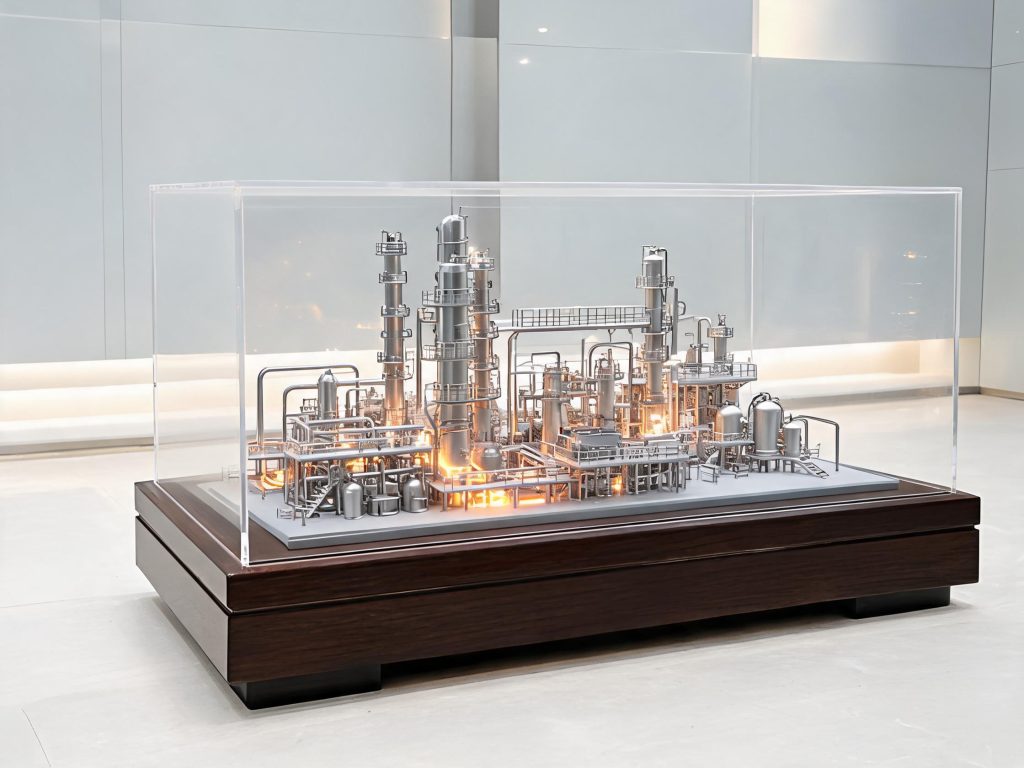
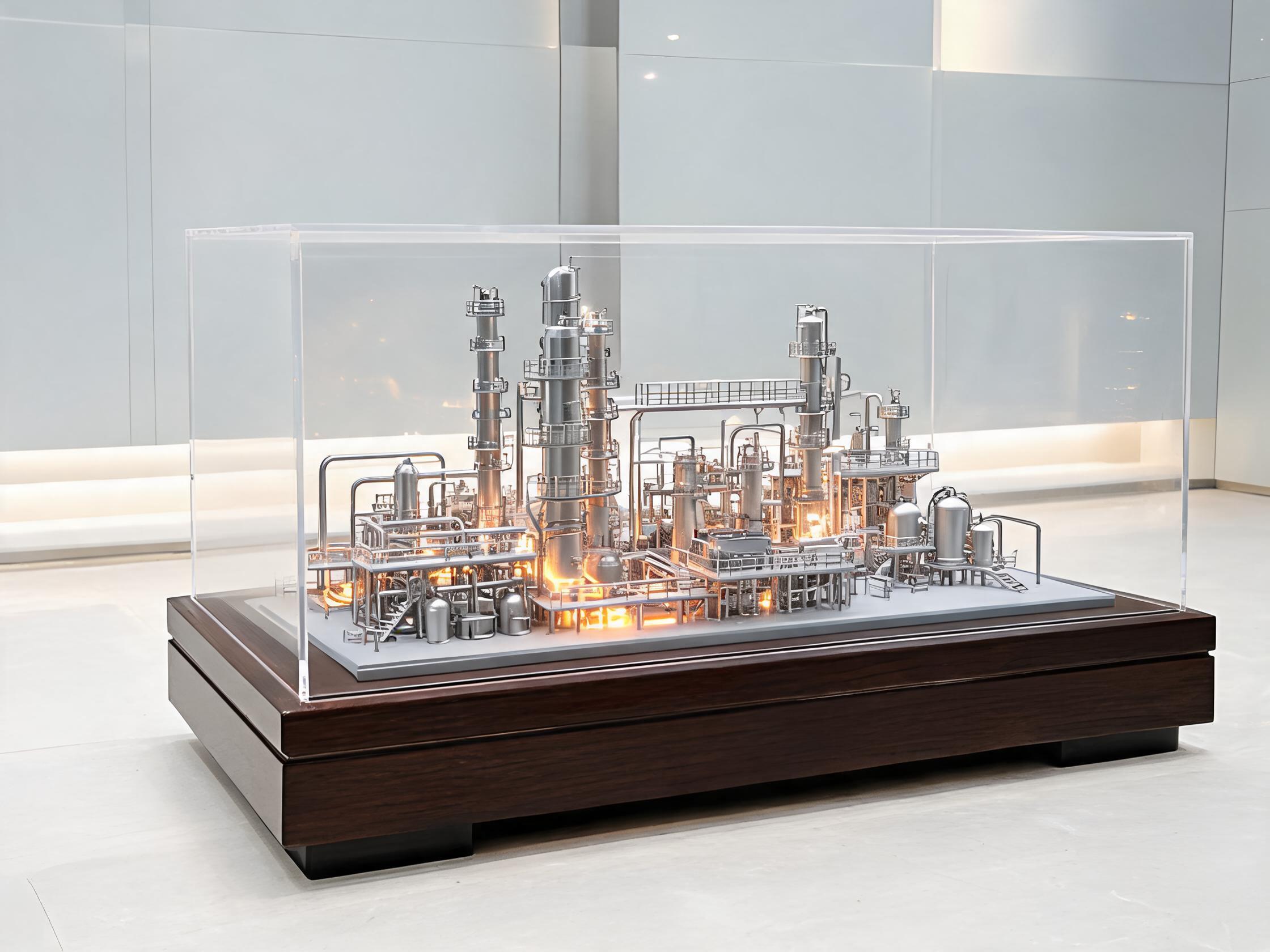
This industrial production line scale model was commissioned by a manufacturing group that needed to explain a complete automated assembly line to investors, government delegations and new production staff — without stopping the real line for a single tour. Built at 1:50 on a 240 cm × 120 cm base, the industrial production line scale model reproduces the whole process from raw material intake to final palletising inside one sealed display case.
Unlike a static architectural model, this piece is a working physical model: conveyor belts actually run, motors turn, status lights sequence, and a PLC panel can start and stop each station in order. Buyers use it for factory showrooms, tender presentations, technical upgrade reviews and smart-manufacturing demonstrations.
What the industrial production line scale model shows
Every station on the real line has a counterpart on the model. Nothing is simplified into a block shape, because the value of a process model is that a visitor can follow material flow without a guide explaining it.
Station-by-station reproduction
- Intake and feeding — hopper, vibrating feeder and screw conveyor, with visible material path
- Processing stations — machining or forming cells with correct machine footprints, tool posts and guard doors
- Transfer system — live belt conveyors, roller sections and lift-and-transfer units driven by micro gear motors
- Inspection and testing — optical inspection booth with a lit screen and pass/fail indicator lamps
- Packing and palletising — case erector, sealing unit and a robot arm that cycles on a timed program
- Control layer — mimic panel with station lamps, emergency stop and a step-by-step run mode
Process flow made visible
The model carries a printed flow overlay on the base: arrows, station numbers and cycle times. Combined with the running conveyors, this lets a presenter walk a group through the line in three minutes instead of fifteen. For technical upgrade reviews, we can add removable “before/after” modules so the same base shows the old and new layout.
Materials and engineering behind the build
A production line model takes more abuse than a display model: visitors touch it, staff restart it hundreds of times, and it runs for years. The build therefore prioritises mechanical durability over surface gloss alone.
- Structure — ABS engineering plastic and sheet-metal frame; load-bearing sections use laser-cut steel with powder coating
- Conveyors — real mini belts on steel rollers, driven by 12 V gear motors with a serviceable belt tensioner
- Machine bodies — CNC-machined ABS with etched panel lines, painted to the client’s RAL references
- Base — composite board with a sheet-metal skirt and levelling feet; cable routing is concealed inside the base
- Control — 24 V control circuit, PLC or relay logic, station-level fusing, and a quick-disconnect for servicing
- Cover — 5 mm cast acrylic hood, hinged or lift-off, so technicians can reach the belts without tools
All wiring is labelled and documented. We ship a wiring diagram, a spare-parts list and a maintenance schedule, because a working model that nobody can service becomes a static one within two years.
Scale, size and layout planning
Scale selection is driven by two numbers: the length of the real line and the space available in the showroom. For most factory displays, 1:50 is the sweet spot — long enough to hold every station, small enough to fit a 2.4 m table. Where the line is short and detail-heavy, 1:30 gives more presence; where the line runs several hundred metres, 1:80 keeps the footprint manageable.
We start from the client’s layout drawing (DWG or PDF) and return a scale proposal with a footprint sketch, station list and lighting plan. Layout changes at this stage cost nothing; layout changes after fabrication cost almost everything.
Specifications
| Item | Standard range |
|---|---|
| Scale | 1:30 / 1:50 / 1:80 |
| Footprint | 150 × 90 cm to 300 × 180 cm |
| Materials | ABS engineering plastic, sheet metal, cast acrylic, extruded foam terrain |
| Motion | Belt conveyors, transfer units, robot arm cycle |
| Lighting | Station status lamps, LED strip, optional zoned lighting per process area |
| Control | PLC with step mode, or relay logic panel |
| Power | 220 V input, 24 V internal circuit |
| Lead time | 35–55 working days after drawing approval |
How this project was delivered
The line was split into four transport sections, each numbered and crated separately. Our technicians attended the on-site installation, levelled the base, re-tensioned the belts after transit and ran a full station cycle test with the client’s process engineer present. Handover included a two-hour training session for the showroom team and a written fault-finding guide.
For overseas clients who prefer to self-install, we ship a pre-wired harness with colour-coded connectors, a step-by-step PDF and a video call slot during commissioning. Most teams complete assembly in one working day.
Questions buyers ask before ordering
Can the model run continuously during showroom hours?
Yes. The drive train is rated for continuous duty, and motors are mounted on serviceable brackets. We recommend a 10-minute rest per hour for long exhibition days, and supply a spare motor with every model above 2 m.
Can we change the layout later?
Station modules are removable. If your line is reconfigured, you can order replacement modules that plug into the same base rather than rebuilding the whole model. This is common with clients who upgrade equipment every two to three years.
Can the model connect to our digital twin or MES demo?
Yes. We can expose the station status lamps through a relay board driven by an external signal, so a live MES or digital-twin dashboard can light the corresponding station on the physical model. This is the setup most industrial exhibition halls now ask for.
Why factories choose our models
We build in our own workshop with our own tooling, pattern shop and paint line, which means layout changes, replacement modules and spare parts stay in one supply chain. More than 1,200 projects have shipped to exhibition halls, government planning centres, museums and corporate showrooms, and every working model leaves with documentation, not just a plug.
If you are planning a factory display, send your layout drawing and showroom dimensions through our contact page and we will return a footprint sketch, scale recommendation and fixed quote within one working day. You can also browse the rest of our industrial scale model range or see the full product catalogue.
For background on how production lines are organised in the real world, this overview of production line design is a useful reference when preparing your own layout drawing.
What drives the cost of a production line model
Price is set by four variables, and knowing them in advance stops the quote from moving later. The first is footprint: a 2.4 m model carries roughly twice the material and labour of a 1.5 m one. The second is the number of moving stations — each conveyor, transfer unit or robot cycle adds a motor, a drive circuit and a commissioning step.
The third is detail density. A line with twenty clearly separated stations costs more than a line with eight, even at the same overall length, because each station needs its own geometry and paint scheme. The fourth is the control layer: a simple relay panel with station lamps sits at one end of the range, a PLC with step-mode sequencing and external signal input at the other.
We quote all four separately, which means you can see what a larger base, extra motion or a smarter control panel actually adds — and decide which of those your showroom really needs.
Related case: urban planning scale model, 1:150 shows the same build method applied to a different site layout.