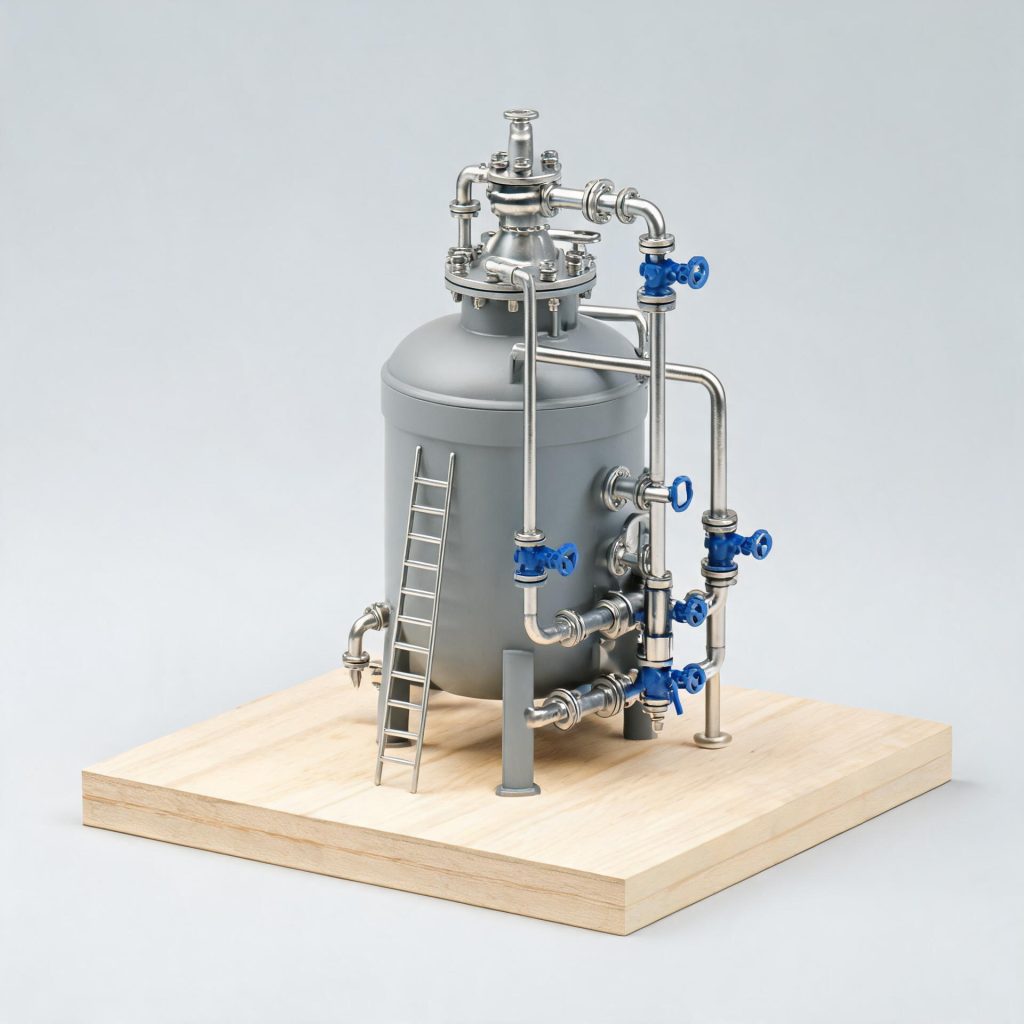
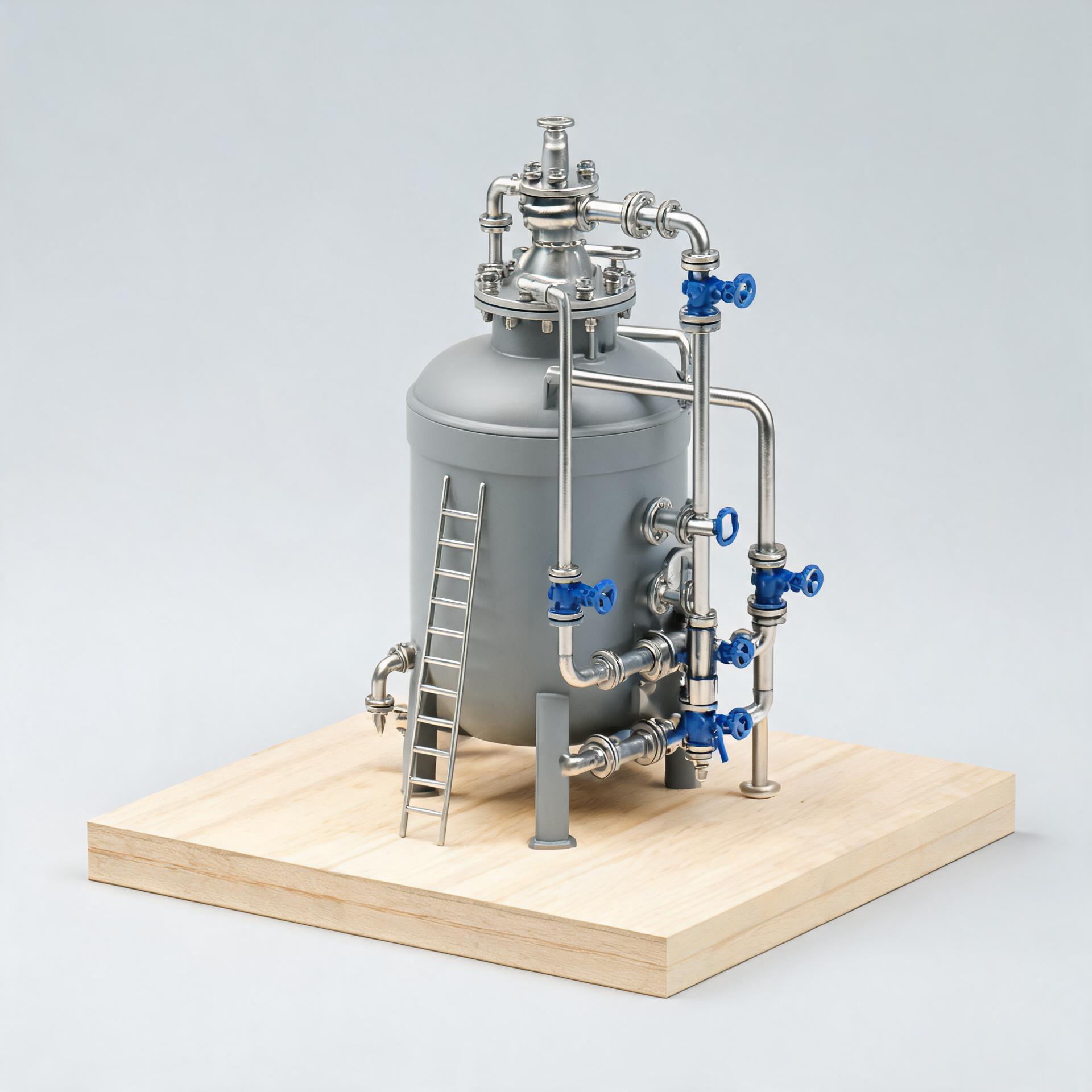
A process equipment scale model exists for one reason: to let a client see a vessel, skid or package unit before it is built, and to let a sales team explain it without opening a P&ID. This one is a 1:20 replica of a jacketed reactor package, complete with piping, valves, access ladder and instrumentation, built as a repeatable product line rather than a one-off.
Because the process equipment scale model is ordered again and again by engineering firms, EPC contractors and equipment vendors, the value is in the standard: consistent detail level, consistent lead time, consistent documentation.
What the process equipment scale model covers
The model reproduces the equipment package as it will stand on site, not as it appears in a catalogue. That means nozzles in the right places, piping that follows the real route, and valves that match the specified type.
Detail level
- Main vessel — shell, dished heads, jacket, support skirt and all major nozzles at scale
- Piping — stainless or painted carbon-steel look, with flanges, elbows, reducers and correct branch routing
- Valves and instruments — ball, butterfly and control valves, pressure gauges, thermowells and level indication
- Access — ladders, platforms, handrails and a maintenance access point that matches the real arrangement
- Structure — skid frame, base plates and anchor points, finished in the client’s standard equipment colour
Configurable options
Options are quoted separately so the base price stays comparable across suppliers. Cut-away sections show internal trays, baffles or agitator geometry. A slow-rotation motor can be fitted so the agitator turns during display. Small flow-lit piping can be added where the model is used to explain a process rather than an object.
Materials and finish standards
These models travel to trade fairs and client offices, so they are built to survive handling without looking worn after the first year.
- Vessel and heads — CNC-machined ABS or cast resin, or turned aluminium where the client wants real metal weight and finish
- Piping — brass tube with plated finish, or ABS tube painted to the specified system colour
- Valves — assembled from machined components, not printed as single blocks, so handles and stems read correctly
- Base — plywood or composite with a painted skirt; optional acrylic dust cover
- Finish — two-pack paint matched to the client’s RAL or Pantone reference, with matt or satin topcoat
Every model ships with a parts index, so a dropped valve handle can be replaced without a new order for the whole unit.
Scale and size options
The default is 1:20, which keeps a two-metre vessel readable at roughly 100 mm while still showing nozzle and flange detail. For a full package unit with skid, piping and platform, 1:30 is more practical because it keeps the overall footprint within a desk or a small display table. For a single large vessel used as a boardroom object, 1:10 gives a strong presence at about 200–300 mm overall height.
Typical product sizes run from a 30 cm desk model to a 150 cm package display. Where the client wants a full skid at exhibition scale, we build up to 200 cm and split the unit into removable sections for transport.
Specifications
| Item | Standard range |
|---|---|
| Scale | 1:10 / 1:20 / 1:30 |
| Overall height | 30 cm to 150 cm |
| Materials | CNC ABS, cast resin, turned aluminium, brass tube, acrylic |
| Finish | RAL / Pantone matched two-pack paint, matt or satin |
| Options | Cut-away section, motorised agitator, flow lighting, acrylic cover |
| Documentation | Parts index, assembly notes, care instructions |
| Lead time | 15–25 working days for standard units |
How orders are handled
We work from a drawing, a datasheet or a photograph, in that order of preference. A general arrangement drawing gives the most accurate result; a nameplate photo plus a dimensioned sketch covers most cases. We confirm nozzle positions, piping routes and paint references in a short drawing review before cutting begins.
Standard units are repeatable: once a pattern is approved, a repeat order skips the review stage and goes straight to production. For clients who order regularly — equipment vendors preparing a series of tender presentations — we keep the pattern on file and quote repeat orders at a lower price.
Packing is a foam-lined crate with the unit braced off the base. Small models ship by courier; anything above 60 cm ships by air freight with the option of an acrylic cover fitted before transit.
Questions engineers ask
How accurate is the piping layout?
It follows the drawing at model scale. Where a real line has field-run piping that changes on site, we model the design intent, not the as-built, and note the difference. If the model is for a specific as-built package, send the revised drawing and we will match it.
Can the model be used for client training?
Yes — this is one of the most common uses. A cut-away vessel with visible internals is easier to explain than a real one, and a demo unit lets operators practise valve sequences without touching live equipment.
Do you supply spare parts?
Yes. Valve handles, gauges, ladder sections and painted components are listed in the parts index and can be reordered individually, usually within a week.
Why equipment vendors standardise on our models
Our workshop handles pattern making, CNC machining, metal turning, painting and assembly in one place, which is why a repeat order is predictable rather than a new project each time. Over 1,200 projects have shipped to engineering firms, EPC contractors, trade fair organisers and corporate showrooms.
Send a drawing or datasheet through our contact page and we will return a fixed quote and a lead time in one working day. You can also compare related work in our equipment model category or review the full product catalogue.
For a technical reference on the equipment type shown here, this overview of chemical reactors explains the vessel and jacket arrangement in plain terms.
How repeat orders stay consistent
Equipment vendors rarely order one model. They order a display unit for a trade fair, then five more for regional sales offices, then a small version for a tender package. Consistency across those orders is the point of working with a factory rather than a studio.
When a pattern is approved we archive it: the CNC files, the paint references, the valve and instrument positions and the finish specification all stay on record. A repeat order two years later is produced from the same archive, so the tenth unit matches the first. That matters more than customers expect — a valve that moves twenty millimetres between two units undermines the credibility of the whole range when they sit on adjacent stands.
We also keep a photograph of the approved first unit, taken under standard lighting, and compare it against every repeat before packing. It is a cheap check that catches paint drift early.
Where a client consolidates several product lines into one model range, we standardise the base, the cover and the nameplate style across the range so the set reads as one family. The equipment differs; the presentation does not.
Related product: architectural tower scale model is built with the same materials and delivery process.