Six clarifiers. One pipe gallery. A council that has never seen either.
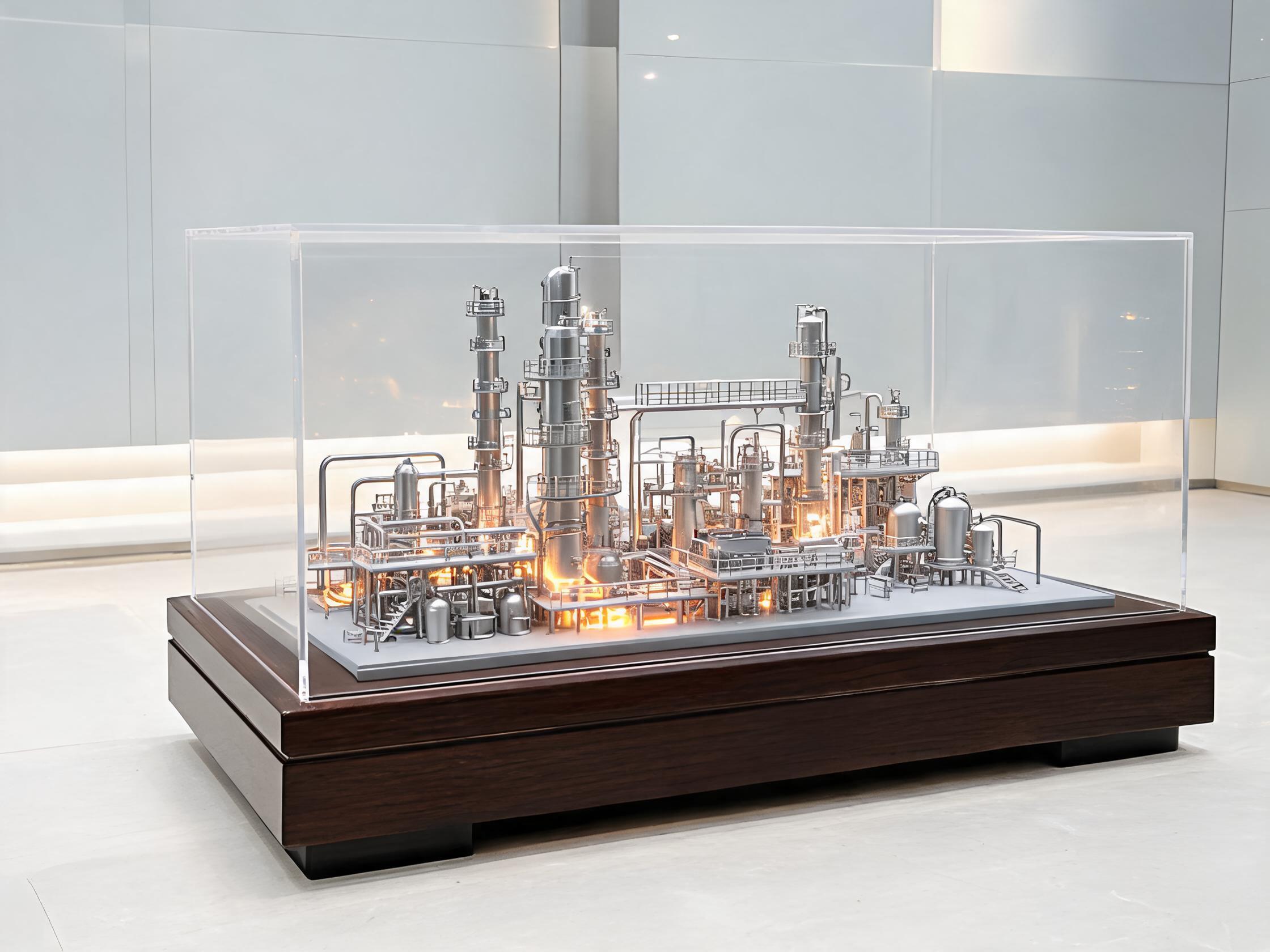
A water treatment plant scale model is the only object in that room that shows how the tanks connect. Not decoration. A working argument on a table.
What a Water Treatment Plant Scale Model Includes
Process plants are a chain, and the chain lives in the connections. Drawings spread it across a dozen sheets. A water treatment plant scale model puts the chain on one base, and the argument about the new filter gallery usually ends in five minutes.
Clarifiers, filters and sludge handling
Circular clarifiers carry visible rake arms, built as real tubes rather than painted lines. Filter galleries show individual cells. Sludge thickening and dewatering sit where they sit on site, not tucked behind a building to save space.
Membrane skids and RO trains
At 1:100 a membrane skid is about 45 mm wide, too small for individual elements. We group the pressure vessels in rows of six, matching the real arrangement, and keep the valve manifold visible. The count stays readable at two metres.
Intake, outfall and buried pipe
Buried lines appear as shallow channels with pipe ends exposed at tie-ins. The route is marked on the base. Coastal plants get an extended base that includes the intake structure and diffuser, because a desalination project is a marine project as much as a process one.
Scales That Keep the Process Readable
- 1:100 — process detail, clarifier diameters around 600 mm, best for training rooms.
- 1:200 — full plant with buildings, roads and tank farm, best for council sessions.
- 1:500 — regional system with reservoirs and pipeline corridors.
We rarely go below 1:200 for a process plant. Pump halls and dosing rooms lose their meaning when they shrink past that. For very large sites we build the process core at 1:200 and add a smaller context base at 1:500 beside it.
What EPC Teams Ask Before Ordering
Can you model a plant still in basic design?
Yes, if the equipment list and plot plan are fixed enough to place tanks. We build to the current revision and mark the scope line. Later changes are handled module by module, not as a rebuild.
Will acrylic tanks yellow?
Cast acrylic holds its clarity indoors for years. We specify UV-stabilised sheet for models near windows and a matte coat on water surfaces. Direct sunlight for hours every day is the one condition we advise against.
What standards guide the layout?
Process layout follows the plant’s own P&ID, and drinking water treatment references come from the US EPA water science program. Desalination projects usually follow local utility specifications, which we ask for at quote stage.
From Plot Plan to Crate
- Send the P&ID, site plan and one elevation.
- Get a fixed quote in one working day, with scale and footprint options.
- Approve layout, colour and pipe detail in a 3D review.
- Build and crate in 20 to 30 days. Clarifiers and buildings travel as removable parts.
Our chemical equipment models follow the same process logic, and the coal industry equipment models show how we handle heavy skids.
Send your plot plan to the contact page and a scale recommendation comes back with the price.